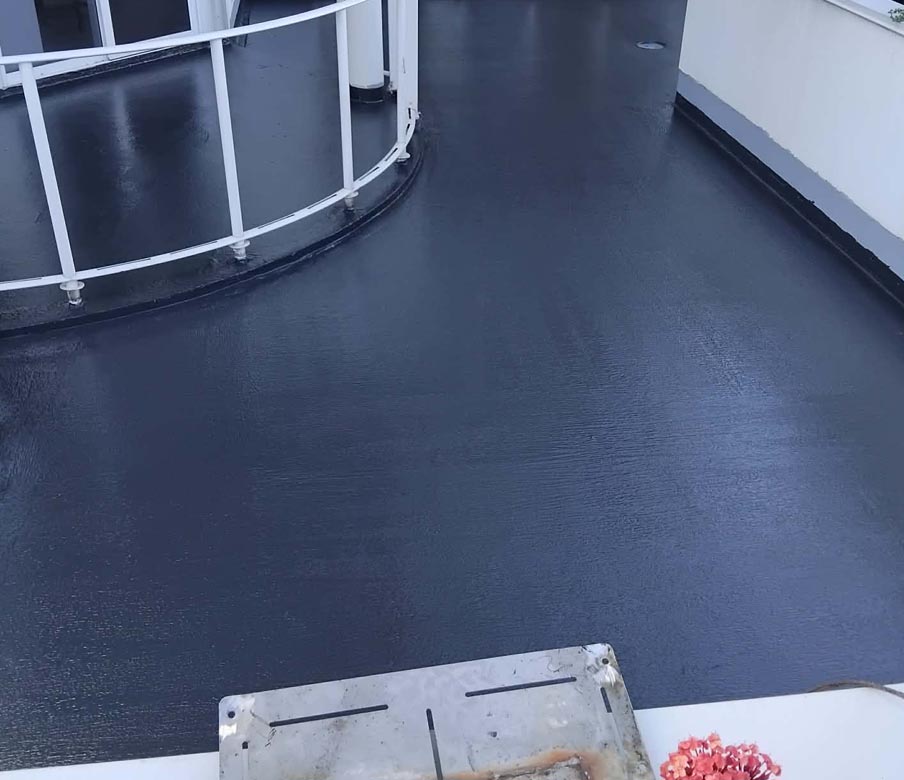

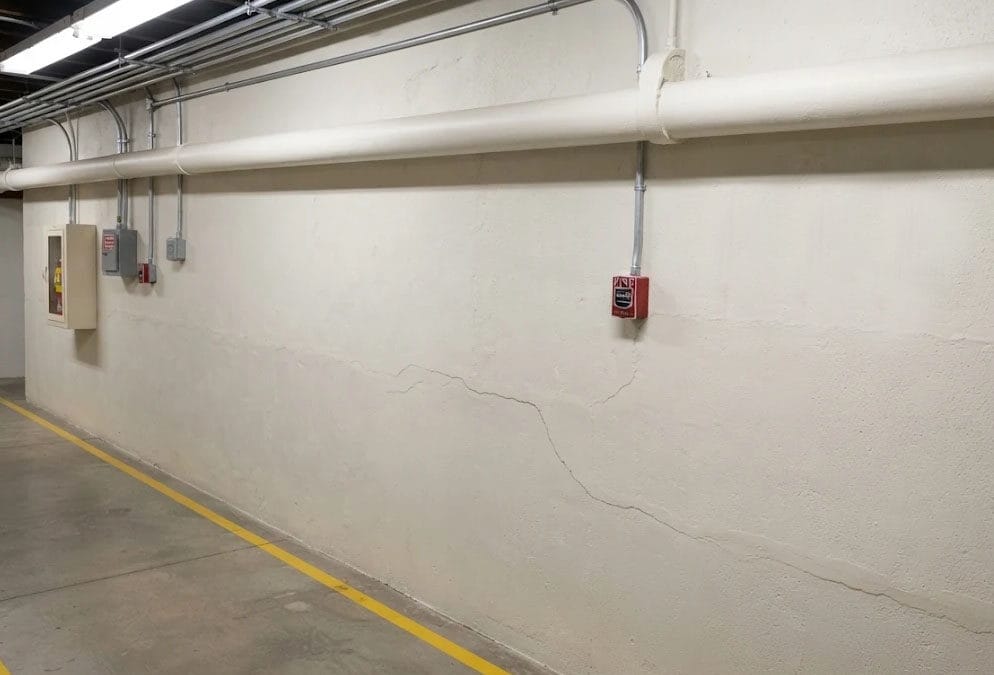
Not every crack in a concrete slab, wall, or basement is an emergency, but some signal water ingress that can lead to structural damage, mould, and costly repairs. Knowing the difference helps property managers and building owners act early.
Concrete cracks can allow water to penetrate commercial buildings, causing dampness, reinforcement corrosion and costly structural damage. Brisbane’s heavy rainfall can worsen existing cracks, particularly in basements, underground car parks and retaining walls.
What Are the Signs That Concrete Cracks Need Waterproofing?

1. Water Leaking Through Cracks
Water dripping or seeping through concrete cracks indicates water ingress. This commonly affects commercial basements, underground car parks, lift pits and retaining walls.

2. White Powdery Deposits
White deposits, called efflorescence, form when moisture carries dissolved salts through concrete. Recurring deposits may indicate ongoing moisture penetration.

3. Rust Stains and Concrete Spalling
Brown stains, flaking concrete and exposed reinforcement may indicate corrosion. These conditions require assessment because waterproofing alone may not resolve structural deterioration.

4. Cracks That Continue to Widen
Expanding cracks may indicate structural movement. A structural engineer should assess potentially structural cracks before waterproofing repairs begin.

5. Persistent Damp Patches and Mould
Damp surfaces, peeling coatings, discolouration and mould around cracks may suggest concealed water penetration, especially in below-ground structures.
How Can You Inspect Concrete Cracks Before Calling a Professional?
Property owners and facility managers can perform a basic visual inspection:
- Locate cracks: Inspect concrete walls, floors, ceilings and construction joints.
- Measure crack width: Use a crack-width gauge and record changes.
- Check for moisture: Look for dampness, water stains, rust and efflorescence.
- Inspect after rainfall: Observe whether cracks become wet or start leaking.
- Document changes: Photograph cracks regularly to monitor deterioration.
Important: Even hairline cracks can allow water penetration. Crack width alone does not determine whether waterproofing is required.
What Is a Crack-Width Gauge?
A crack-width gauge (also called a crack comparator or crack monitor) is a simple tool used to measure how wide a crack is in concrete, brickwork, or masonry. It helps building owners and inspectors decide whether a crack is minor or needs professional attention, such as Commercial Waterproofing in Brisbane.
Common Types of Crack-Width Gauges

Digital Crack Gauge
Crack comparator card: A clear plastic or printed card with lines of different thicknesses (for example, 0.1 mm to 2 mm). You hold it over the crack and match the line that fits the crack width.
- Crack monitor (tell-tale gauge): Two overlapping plastic plates fixed across a crack. If the crack widens or shifts, the plates move apart and show the change on a printed grid.
- Digital crack gauge: An electronic device that gives precise readings, often used in structural monitoring.
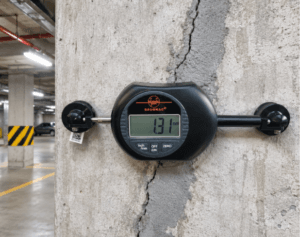
How to Use a Crack-Width Gauge
- Clean dust and debris from the crack and surrounding surface.
- Place the comparator card flat against the concrete over the widest part of the crack.
- Match the crack to the closest line thickness and record the measurement.
- For monitors, fix the gauge across the crack, note the starting position, and check it weekly or monthly.
- Photograph and date each reading to track changes.
Here is a guide on how to evaluate concrete cracks and determine when to call in professional commercial waterproofing Brisbane services.
1. Crack Width and Classification
The physical dimensions of a crack dictate whether it can be managed with basic maintenance or requires professional injection and waterproofing membranes:
Hairline Cracks (Less than 1 mm): Typically caused by normal concrete shrinkage or curing. While common, they can still allow moisture vapor transmission if left exposed in high-humidity environments.
Medium Cracks (1 mm to 3 mm): Often active cracks caused by minor thermal movement or settling. These require flexible sealants or elastomeric coatings to prevent water ingress during heavy Brisbane downpours.
Structural Cracks (Greater than 3 mm): Wide, deep fractures that indicate load-bearing stress, foundation movement, or rebar corrosion. These demand immediate professional engineering and commercial waterproofing intervention.
2. Location and Water Exposure Zones
Where the crack appears determines the urgency and the type of waterproofing system required:
Below-Grade Walls and Basements: Cracks in subterranean concrete are subjected to hydrostatic pressure from surrounding saturated soil. Even hairline cracks here will actively leak during heavy rain and require specialized positive-side or negative-side waterproofing solutions.
Balconies and Podium Decks: Cracks on flat horizontal surfaces allow pooling water to infiltrate the slab, leading to concrete spalling and structural degradation.
Expansion Joints and Control Joints: Cracking adjacent to joints usually points to joint sealant failure, which compromises the entire waterproof envelope of the building.
Why It Matters for Waterproofing
Cracks wider than about 0.3 mm can allow water to reach steel reinforcement, leading to corrosion and concrete cancer. A gauge shows whether a crack is stable or active (growing). Active cracks usually need flexible waterproofing systems, while stable cracks may be suited to injection or sealing. Sharing gauge readings with a specialist in Brisbane Commercial Waterproofing speeds up assessment and helps them recommend the right repair.
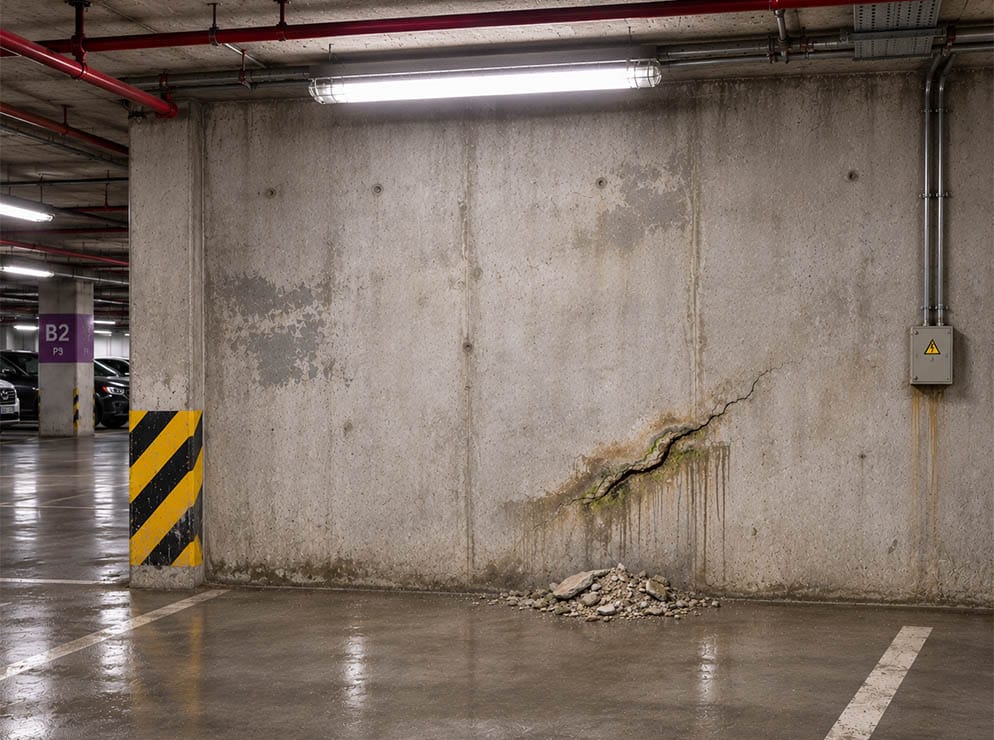
Basement Wall with Active Crack
What Brisbane Commercial Waterproofing Solutions Are Available?
The appropriate repair depends on the crack’s condition, movement, location and source of water ingress.
| Waterproofing Solution | Suitable Application |
|---|---|
| Polyurethane Crack Injection | Sealing suitable water-leaking concrete cracks |
| Epoxy Crack Injection | Structural crack repairs where appropriate |
| Positive-Side Waterproofing | Protecting externally exposed concrete surfaces |
| Negative-Side Waterproofing | Managing water ingress from accessible internal surfaces |
| Concrete Joint Sealing | Sealing leaking construction and movement joints |
Frequently Asked Questions
Q. Can hairline concrete cracks cause water leaks?
Yes. Even narrow cracks can allow moisture penetration, particularly in underground structures exposed to hydrostatic pressure.
Q. When should commercial concrete cracks be professionally inspected?
Arrange an inspection when cracks leak repeatedly, continue widening, develop rust stains or show concrete deterioration. Suspected structural damage requires engineering assessment.
Q. Is a gauge enough to diagnose a crack?
No. It measures width and movement only. A qualified waterproofing or structural professional should assess the cause and recommend repairs.
Need Professional Commercial Waterproofing-Brisbane or Gold Coast?
Water ingress through concrete cracks can lead to costly repairs and operational disruptions. S&S Remedial provides commercial waterproofing and concrete remedial services across Brisbane and the Gold Coast, including polyurethane crack injection, epoxy crack repair, joint sealing and basement waterproofing.
Request a Waterproofing Assessment